For an NYC pop-up shop or storefront window, the right LED screen is the one sized to the glass, bright enough to read against daylight from the sidewalk, and fine enough in pitch for shoppers standing a few feet away. In practice that usually means a modular wall built to your window dimensions, a high-brightness panel for street-facing glass, a fine pitch for in-store walls, and a short content loop made for walk-by traffic.
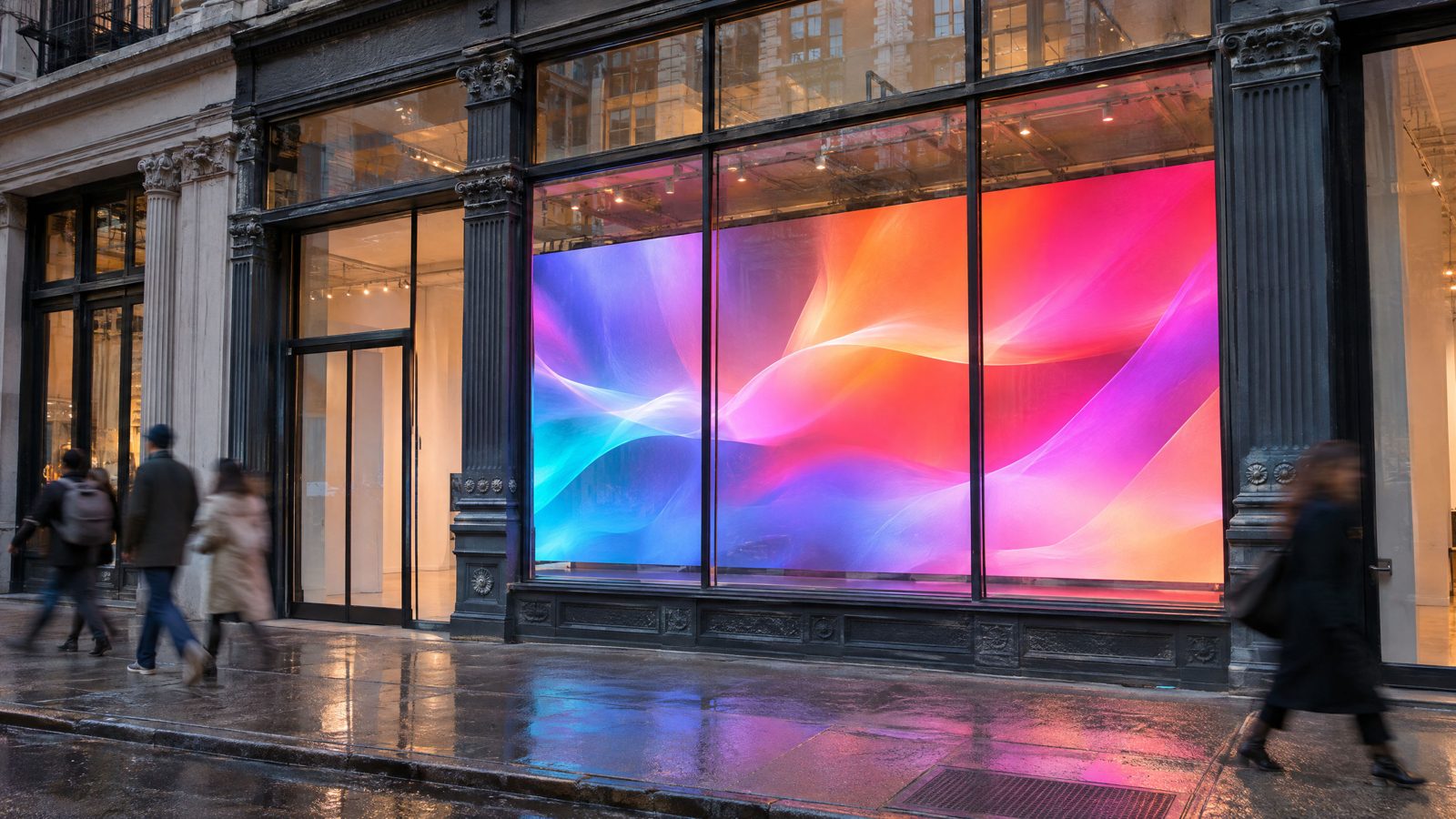
A pop-up runs on a short clock: days or weeks to turn a borrowed space into something people stop for. Here is how we help brands and agencies choose the screen. If the pop-up hosts a runway or presentation, our fashion show LED wall guide covers that setup, and our LED backdrop and photo wall guide covers the in-store photo moment.
Window-facing screens vs. in-store walls
A pop-up shop display usually does one of two jobs, and they call for different screens.
The LED window display
A window screen faces out to a moving audience: the sidewalk, passing cabs, across the street. It has to win a glance in a couple of seconds, through glass, often in daylight. Brightness and bold content matter more than ultra-fine detail.
The in-store wall
An in-store LED screen for a pop-up shop faces in. Shoppers stand close, browse, and take photos, so the priorities flip: a fine pixel pitch for crisp type and product shots, and brightness set to a comfortable indoor level. Many pop-ups use both: a window screen to pull people in and a feature wall inside that doubles as the photo moment. Our product launch and brand activation guide covers the photo-wall side in more depth.
Brightness for street-facing glass
Daylight is the main enemy of a window display. Our indoor walls run about 800–1,500 nits, which looks great inside a store but can look washed out behind a sunny window. Outdoor-rated panels go up to about 5,000 nits. As general guidance, high-brightness panels are often used behind street-facing glass, especially on a sunny side of the street or in a window that gets midday sun.
- Glass costs you light. Tinted or coated glass and street reflections reduce how bright the screen reads from outside.
- Brighter is not always better at night. A wall set for noon can feel harsh after dark, so brightness should be turned down after dark.
- Heat builds up in a window bay. Sun plus a running screen in an enclosed window gets warm. Leave room for airflow behind the panels.
- Static content ages a screen. A logo or price frozen on the glass for weeks is the classic cause of image retention; our LED screen burn-in guide explains how to avoid it.
Our nits vs. lumens guide explains how brightness is measured and why it matters so much near daylight. If your pop-up spills onto the sidewalk itself, see outdoor LED wall rental for weatherproofed outdoor-rated options, and our outdoor big screen guide for larger street-level builds.
Pixel pitch and sizing for small footprints
Pixel pitch is the distance between LEDs, and it decides how close someone can stand before the image breaks into dots. A working rule: minimum viewing distance in meters is roughly the pitch number (P2.6 is about 2.6 m, or about 9 ft), while the comfortable "10x rule" puts distance in feet at about pitch × 10.
Shoppers often stand closer than that, so for in-store walls and anything people photograph, a fine pitch (roughly P1.5–P2.6 is common) is the usual starting point. For a window read from the sidewalk, the distance from glass to foot traffic sets the pitch, and a slightly coarser panel can be fine. Our guide to pixel pitch, nits, and resolution goes deeper, and P1.875 vs. P3.91 shows the trade-off side by side. If shoppers can reach the screen, our COB vs. SMD comparison explains how the panel surface differs. If product and staff need to stay visible through the window, see our transparent LED guide; it is a specialty product we source to the project.
NYC retail spaces are rarely generous, but LED walls are modular. Panels come in standard cabinet sizes, so the wall builds to the width, height, and aspect ratio of your window: a tall, narrow bay, a column wrap, or a low strip above a counter. Our panel sizes guide shows how to count panels for a given opening, and the LED wall calculator turns your dimensions into a rough size and budget. Measure the clear glass area (minus frames), the depth behind the glass for panels and a support frame, and any ceiling, sprinkler, or signage conflicts.
What it costs, and how LED compares
On our published pricing, booth-scale walls (about 10×6 to 12×8 ft) typically run $5,000–$6,000 per day all-in: panels, basic processing, ground-stack rigging, NYC delivery, setup and strike, and an on-site tech. Extra days typically bill at about 20% of day one, and weekly rates are cheaper still. Outdoor-rated panels add roughly 20–50% over a comparable indoor wall. Pop-ups running several weeks are priced to the run, so ask for a quote with your dates, size, and location. For a screen that stays in the window long-term, see our permanent LED video wall installation service, or the LED screen rental page for short-term hire.
| Option | Strengths | Limits for a pop-up |
|---|---|---|
| LED wall | Seamless at any size; high brightness available for windows; motion and content changes on a cue | Higher day rate than a TV; needs power, a support structure, and install time |
| LCD / TV video wall | Familiar, sharp up close, works for small in-store screens | Visible bezels between screens; fixed sizes; standard displays can struggle against direct daylight |
| Printed window graphics | No power, no tech, reads fine in sun | Static; one message for the whole run; reprinting means new production |
| Projection | Can cover odd surfaces; works in dark rooms | Washes out in daylight and lit stores; shoppers cast shadows; needs throw distance |
Many pop-ups mix these: printed graphics for wayfinding and pricing, LED for the hero moment. Our LED wall rental page covers the full range of builds, and our TV rental vs. LED wall comparison helps if a small screen might be enough. For the terminology, see video wall vs. LED wall.
Short-run logistics in NYC retail spaces
The install is often the hardest part of a pop-up shop in NYC. Plan around these early:
- Access. Ask whether there is a freight elevator, a loading entrance, or only a front door. Panel cases are heavy and need a clear path.
- Landlord and building rules. Many buildings set install hours, require a certificate of insurance, or limit what can attach to walls and floors. Get the rules in writing before you book.
- After-hours installs. Retail neighbors and sidewalk traffic often push load-in to early morning or overnight. Build that into the schedule; our overnight install guide covers how that works.
- Power. Confirm which circuits are available near the screen and whether they are shared with lighting or other equipment. Small walls may run on standard circuits; larger builds may need dedicated power, which we quote separately.
- Support. A window wall usually ground-stacks on a frame behind the glass. Flown rigging, if the space allows it, is a separate line item; see ground stack vs. flown rigging for the difference.
Send us the floor plan, photos of the window and access path, and the building's rules, and we will flag issues before install day. Not sure which borough fits? Our LED screen rental near me guide covers Manhattan, Brooklyn, Queens and the Bronx.
Content loops for walk-by traffic
Most people see a window display for a few seconds while walking. Content that works there is short, bold, and readable without sound: one idea per scene, large type, strong contrast, and a loop that restarts cleanly without a jump. Inside the store, you can slow down with longer product stories and a calmer photo-friendly backdrop.
We design content in house, built to the wall's exact pixel canvas, so nothing is stretched or soft. Because the screen is digital, you can change the message mid-run for a new drop, a weekend event, or evening hours. A video processor maps your content to the wall; our video wall processor explainer covers what it does. Custom content and motion are quoted separately from the wall.

Frequently asked questions
How bright does an LED window display need to be?
It depends on how much sun the window gets and how much light the glass blocks. Our indoor walls run about 800–1,500 nits, which can wash out behind sunny glass. Outdoor-rated panels go up to about 5,000 nits, and high-brightness panels are often used for street-facing windows. Brightness can be set on site and lowered after dark.
What pixel pitch is right for a pop-up shop display?
For in-store walls where shoppers stand close or take photos, a fine pitch (roughly P1.5–P2.6 is common) keeps type and products crisp. A window screen read from the sidewalk can often use a slightly coarser pitch. A working rule: minimum viewing distance in meters is roughly the pitch number, so P2.6 looks clean from about 9 ft.
How much does it cost to rent an LED screen for a pop-up shop in NYC?
Booth-scale walls, about 10×6 to 12×8 ft, typically run $5,000–$6,000 per day all-in on our published rates, including panels, processing, ground-stack rigging, NYC delivery, setup, strike, and an on-site tech. Extra days typically bill at about 20% of day one. For multi-week runs, send your dates for a quote.
Can an LED screen fit a small storefront window?
Usually, yes. LED panels are modular, so the screen builds to the width and height of your window rather than a fixed TV size. We need the clear glass dimensions, the depth behind the glass, and photos of the space to plan the layout and support frame.
Do you create the content for pop-up shop screens?
Yes. We design content in house at the wall's exact resolution, from short walk-by loops for the window to slower product stories inside. Your agency can also supply finished files; we send the canvas size and specs so they play correctly. Custom content is quoted separately from the wall rental.
Can I hire an LED screen for a weekend pop-up near me in NYC?
Yes. LED screen hire is priced per day on our published rates, and extra days typically bill at about 20% of day one, so a weekend or a few days is a normal request. We deliver within NYC, set up, and strike. Send your dates, window or wall size, and address for a quote.
Will a static logo burn into an LED window display?
Modern LED panels are far less prone to permanent burn-in than older display types, but a frozen frame left on for weeks can still cause uneven wear or retention. Keep content moving, rotate the hero frame, and lower brightness after dark. Our burn-in guide covers the details.
Planning a pop-up or a storefront window in NYC? See our LED walls for pop-up shops page, or tell us about your space for a same-day quote.