An LED video wall is built from modular panels, and the most common rental size is 500 × 500 mm, about 1.64 ft on each side. To work out how many you need, convert the wall size to meters and divide each side by 0.5: a 16 × 9 ft wall comes to roughly 10 × 6 = 60 panels. The pixel pitch then sets how many pixels each panel carries, which decides the resolution of the whole wall.
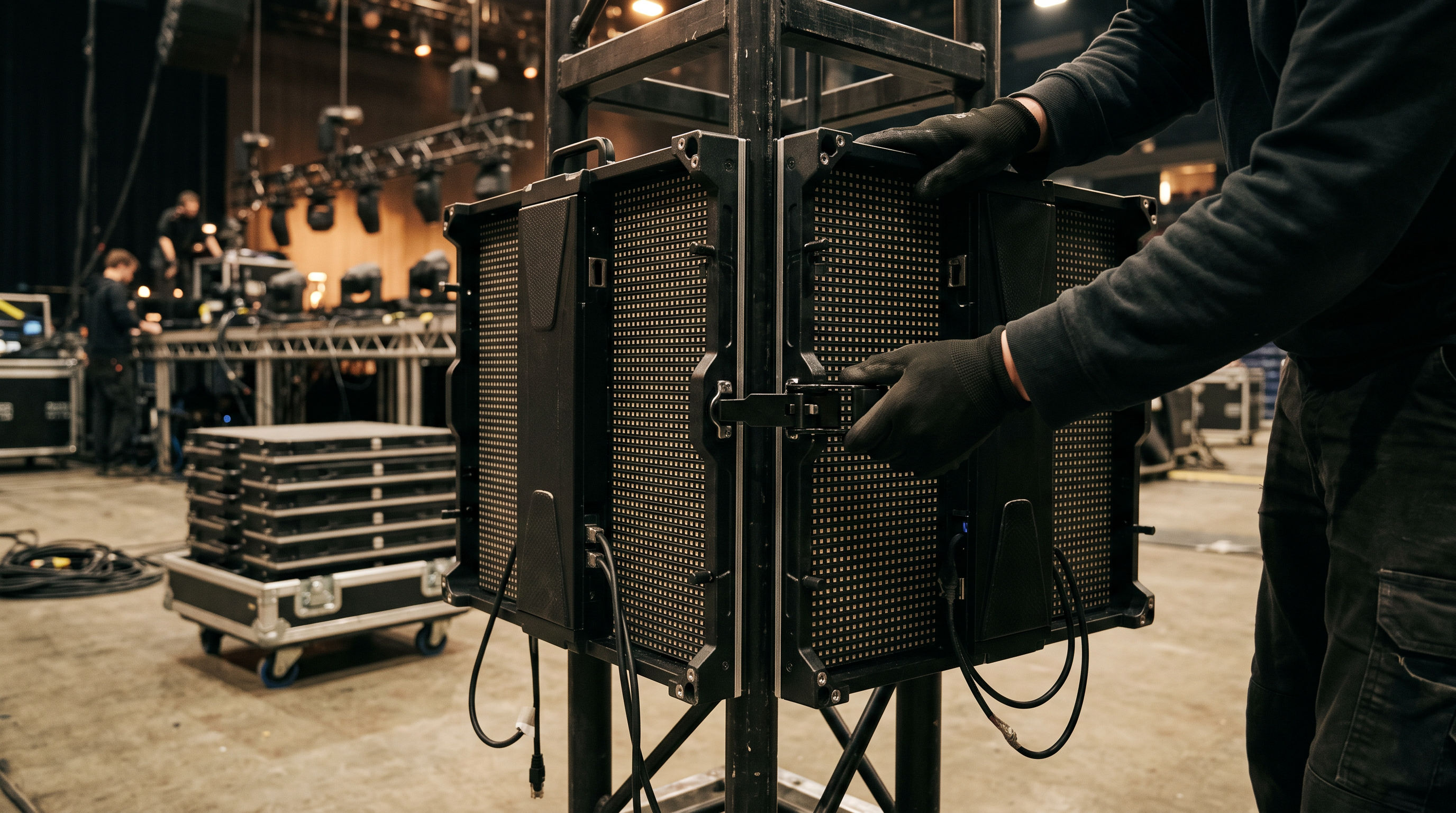
Below we break down what a panel actually is, the sizes you will see on quotes, a panel-count table for common event walls, and what changes when you pick a finer or coarser pitch.
What an LED video wall panel actually is
When people say "LED wall panels" they usually mean cabinets. A cabinet is the frame that holds the electronics: power supply, receiving card, data and power connectors, and the locking hardware that joins it to the next cabinet. The visible LED surface on the front is made up of smaller modules that attach to the cabinet.
Cabinet vs module
- Cabinet (panel): the unit you count, ship and stack. It sets the building block size of the wall.
- Module: the LED tile on the face of the cabinet. If a few pixels fail, the module is swapped out on site. That is why spare modules travel with every wall and maintenance is handled as module-level replacement.
Why panels instead of one big screen
Because the wall is modular, the same inventory can build a 10 × 6 ft booth backdrop one week and a 24 × 12 ft stage wall the next. The panels lock together with no bezels, so the finished wall reads as one seamless image.
Common LED panel sizes
Most of what you will see on rental quotes falls into two shapes:
- 500 × 500 mm: the most common rental cabinet in the industry. Walls grow in 0.5 m (about 1.64 ft) steps in both directions, which makes it easy to fit odd-sized rooms and backdrops. We use it for the panel-count math in this guide.
- 500 × 1000 mm: also common in the industry. Taller cabinets mean fewer units and connections on large walls, at the cost of coarser height steps.
Curved, corner and column builds use the same modular idea with different locking hardware. If you want to see how those come together, read our guide to curved LED walls.
How many LED panels do I need?
The quick method for 500 × 500 mm panels:
- Convert width and height from feet to meters (multiply by 0.3048).
- Divide each side by 0.5 and round to a whole number of panels.
- Multiply columns by rows.
The table below rounds up, so the built wall is slightly larger than the target. In practice we often round down instead to fit a stage or a ceiling height. Treat these as approximate counts, not a quote.
| Target wall (ft) | Panels (cols × rows) | Total panels | Built size (approx. ft) | Resolution at P2.6 |
|---|---|---|---|---|
| 10 × 6 | 7 × 4 | 28 | 11.5 × 6.6 | 1344 × 768 |
| 12 × 8 | 8 × 5 | 40 | 13.1 × 8.2 | 1536 × 960 |
| 16 × 9 | 10 × 6 | 60 | 16.4 × 9.8 | 1920 × 1152 |
| 20 × 12 | 13 × 8 | 104 | 21.3 × 13.1 | 2496 × 1536 |
| 24 × 12 | 15 × 8 | 120 | 24.6 × 13.1 | 2880 × 1536 |
| 30 × 14 | 19 × 9 | 171 | 31.2 × 14.8 | 3648 × 1728 |
If you would rather not do the math, our LED wall calculator does it for you, and the event sizing guide covers how big the wall should be for your room and audience in the first place. Not sure whether you need an LED wall or a tiled video wall? See video wall vs LED wall.
Pixel pitch and pixels per panel
Pixel pitch is the distance between pixel centers in millimeters. On a 500 mm panel, divide 500 by the pitch to get pixels per side:
- P1.9: about 256 × 256 pixels per panel (the actual pitch is closer to 1.95 mm).
- P2.6: about 192 × 192 pixels per panel.
- P3.9: about 128 × 128 pixels per panel.
Same panel count, very different resolution. A 16 × 9 ft wall at P2.6 is about 1920 × 1152 pixels. The same wall at P3.9 is about 1280 × 768, and at P1.9 about 2560 × 1536.
Which pitch for which distance
Our rule of thumb: the minimum viewing distance in meters is roughly the pitch number, so P2.6 works from about 2.6 m (about 9 ft). The comfortable "10x rule" puts the distance in feet at about pitch × 10, so roughly 26 ft for P2.6 and 39 ft for P3.9. Our inventory covers a range of pitches: finer pitches for close audiences and photos, coarser pitches for large and outdoor walls. Fine pitch can cost about 30–50% more than coarser pitch. More detail in our guide to pitch, nits and resolution, and in P1.875 vs P3.91 for a head-to-head comparison.
How much do LED panels weigh?
Rental cabinets are typically light die-cast aluminum, designed to be handled by hand and locked together. Exact weight varies by manufacturer, pitch and cabinet size, so the spec sheet for the specific product is the only number to trust.
Weight matters in two places:
- Ground-stacked walls: the total load sits on the floor or stage through a base and support frame. Stages and raised floors need to carry it.
- Flown walls: the wall hangs from rigging points, which have to be rated for the total load including hardware. Venues will usually ask for the numbers in advance.
We work out structure and load for every build. The trade-offs are covered in ground stack vs flown rigging.
Panels are only part of the wall
A pile of panels is not a working screen. Every wall also needs a processor to map your content to the exact pixel count, power distribution, data cabling, a support structure and someone who knows the system. Our day rates are all-in: panels, processing, rigging, delivery and an on-site technician. Most NYC event walls fall between $5,000 and $15,000+ per day, with a Booth-size wall (10 × 6 to 12 × 8 ft) around $5,000–$6,000 and a Stage-size wall (16 × 9 to 24 × 12 ft) around $7,000–$15,000. Extra days run about 20% of day one. See the full breakdown on our pricing page.
Panel choice also shapes the look of the wall: see our LED backdrop guide for stage and photo-wall builds, the outdoor jumbotron guide for weatherproof walls, and the burn-in guide for why rental walls stay clean.
Frequently asked questions
What size are LED video wall panels?
The most common rental panel is 500 × 500 mm, about 1.64 ft square. Panels of 500 × 1000 mm are also common in the industry for larger walls. Because the wall is modular, the finished size grows in 0.5 m steps, so a wall can be fitted closely to a stage, booth or room.
How many LED panels do I need for a 16 × 9 ft wall?
With 500 × 500 mm panels, a 16 × 9 ft wall needs about 10 panels across and 6 high, or 60 panels in total. That builds to roughly 16.4 × 9.8 ft. At P2.6 pitch, the wall comes out at about 1920 × 1152 pixels, which is close to full HD width.
How many pixels are on one LED panel?
Divide the panel width in millimeters by the pixel pitch. On a 500 mm panel, P1.9 gives about 256 pixels per side, P2.6 about 192, and P3.9 about 128. Multiply by the number of panel columns and rows to get the resolution of the full wall.
What is the difference between an LED cabinet and an LED module?
The cabinet is the frame you stack and lock together. It holds the power supply, receiving card and connectors. Modules are the smaller LED tiles mounted on the cabinet face. If pixels fail during an event, a technician swaps the module rather than the whole cabinet, which is why spare modules travel with every wall.
Can I rent LED panels without a technician?
Our rentals are all-in: delivery, setup, processing and an on-site technician are part of the day rate. A working wall depends on correct processing, power and mapping, so having someone who knows the system on site protects the event.
Can I hire LED screen panels for just one day in NYC?
Yes. A single-day LED screen hire is a standard booking. The day rate covers the panels, processing, rigging, delivery, setup and strike, and an on-site technician. Tell us the date, venue and wall size and we will send a same-day quote with the panel count worked out. For borough-by-borough details, see LED screen rental near me in NYC.
Tell us the wall size, room and date, and we will send a same-day quote with the panel count, pitch and layout worked out. Start with our LED panel rental page or contact us directly.