The right LED screen for an event comes from seven decisions, in order: what kind of event it is, how close the nearest viewer stands (which sets pixel pitch), indoor or outdoor brightness, size and aspect ratio, rigging, content and playback, and budget. For most NYC indoor events that means a P1.9–P2.9 wall between about 10×6 and 24×12 ft, and on our published rates most event walls run $5,000–15,000 per day all-in.

Get the order right and the rest of the spec falls into place. Below is how we walk through it with every client, with typical numbers for each kind of event. If you already know you want a screen for a one-night event, our LED screen rental for events page shows what a build includes.
Decision 1: start with the event type
The event decides who is watching, how close they get, and what the wall has to do. A keynote wall carries slides and a live feed of the speaker. A wedding backdrop gets photographed from a few feet away. A festival screen has to read in direct sun from across a field. Here are the starting points we use. Treat them as typical ranges, not guarantees; your room and audience set the final spec.
| Event type | Typical pitch | Typical size | Notes |
|---|---|---|---|
| Corporate keynote | P1.9–P2.9 | 16×9 to 24×12 ft | 16:9 takes decks and video as is; finer pitch if the speaker feed is streamed or recorded |
| Gala or fundraiser | P2.5–P2.9 | 16×9 to 24×12 ft | Side screens added in larger rooms; check ceiling clearance early |
| Wedding | P1.9–P2.6 | Between 10×6 and 16×9 ft | Guests and photographers get close, so pitch matters more than size |
| Concert or DJ | P2.6–P3.9 (finer for DJ walls) | DJ walls smaller; main stages 24×12 ft and up, often flown | Crowd stands back; effort goes into brightness, rigging, and content |
| Trade-show booth | P1.5–P2.6 | 10×6 to 12×8 ft backwall | Visitors stand within a few feet; venue labor and power rules apply |
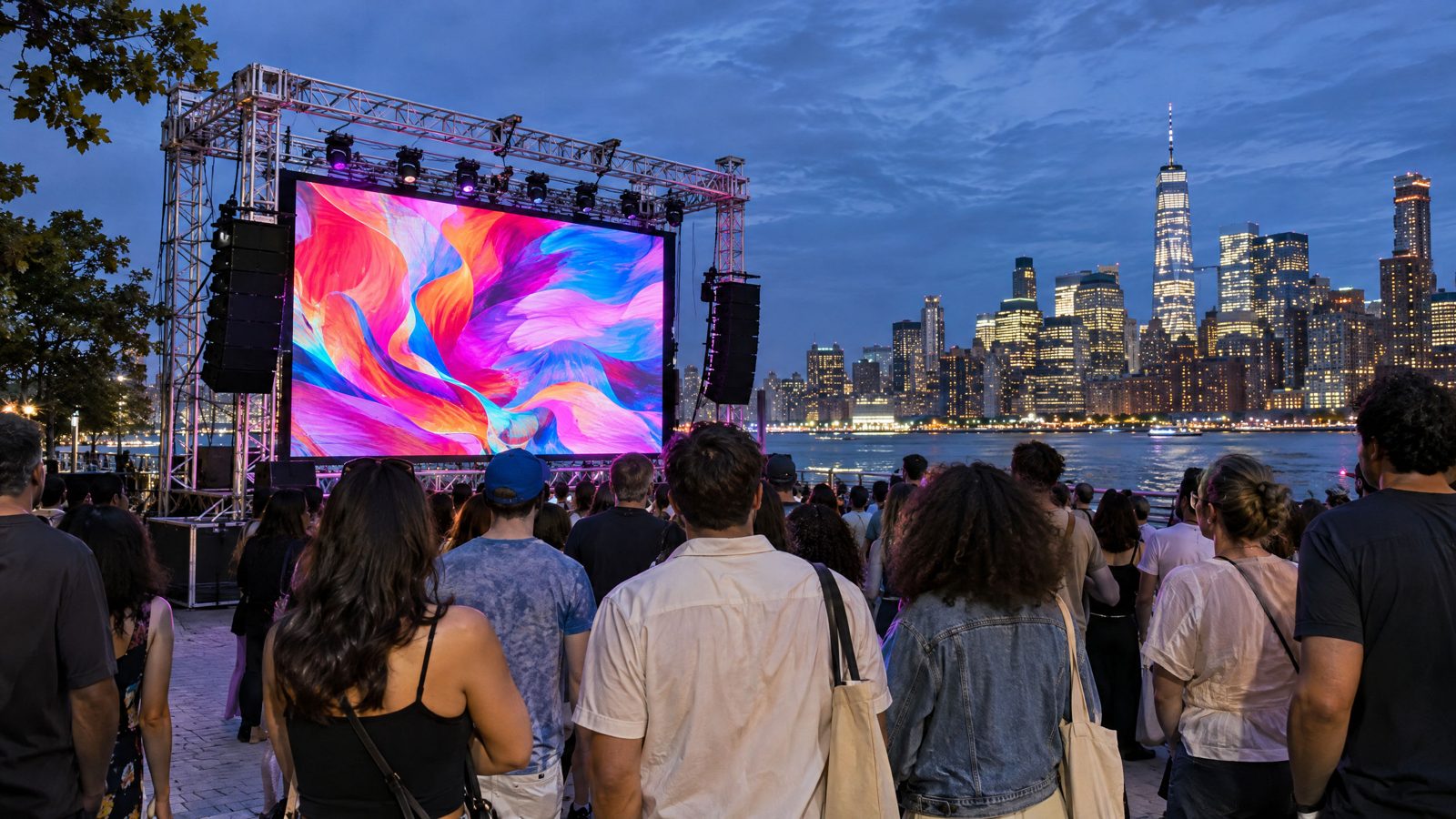
| Outdoor festival or fan zone | P3.9 outdoor | Sized to the field; large main walls 24×12 ft and up | Up to about 5,000 nits, outdoor-rated panels, wind-load rigging |
| House of worship | P1.9–P2.6 | Image height about 1/8 to 1/6 of the distance to the back pew | Lyrics and scripture must read from the last row with house lights up |
Each of these has its own guide: conferences and keynotes, galas and fundraisers, weddings, concerts and live music, trade shows, houses of worship, fashion shows, and product launches and brand activations. For a storefront or activation, see LED screens for pop-up shops.
A note on DJ LED screens and party walls
A DJ LED screen is usually smaller than a full stage backdrop, but the crowd stands right in front of it, so it gets looked at hard. That is why we often go finer on pitch for a DJ wall than for a concert main stage. It can sit behind the booth or wrap the front of it, and it looks strongest with beat-driven loops built for its exact resolution rather than a stock visuals pack. Want the dance floor lit too? LED floor tiles are sourced to order rather than kept in stock; see our LED dance floor rental guide.
Decisions 2 and 3: viewing distance and brightness
Decision 2: the closest viewer sets pixel pitch
Pixel pitch is the distance in millimeters between LEDs. A smaller number means a sharper image up close and a higher price; fine pitch can cost about 30–50% more than a coarser pitch. Our working rule: the minimum viewing distance in meters is roughly the pitch number, so a P2.6 wall looks smooth from about 2.6 m (around 9 ft). The more comfortable "10x rule" puts the ideal distance in feet at about the pitch times 10.
Measure the closest viewer who matters, such as the front row, a guest at the backdrop, or a phone held up to the screen. Then pick the coarsest pitch that still looks clean at that distance. For the trade-offs, read P1.875 vs P3.91, the full pixel pitch, nits and resolution guide, and COB vs SMD LED displays if durability or close-up viewing matters.
Decision 3: indoor or outdoor brightness
Brightness is set by the environment, not the pitch. Our indoor walls run about 800–1,500 nits, which is plenty for a ballroom, stage, or conference room, with room to turn down in a dark space. Outdoors, a wall in direct sun needs up to about 5,000 nits, and outdoor panels need to be weatherproofed against rain and dust. Outdoor typically adds about 20–50% to the cost of a comparable indoor wall. More on this in nits vs lumens and our outdoor LED walls guide; for a screening or watch party, see outdoor movie screen rental or outdoor big screen and jumbotron rental.
Decision 4: size and aspect ratio
Size the wall from the farthest seat, then check what the room allows. As a rough guide from our sizing work, a 50–150 person event often needs a backdrop around 10–12 ft wide by 6–7 ft tall, a 200–500 person session about 16–24 ft by 9–12 ft, and larger rooms 24–40 ft wide. Ceiling height often caps the wall first: a 12 ft image usually wants 14 to 16 ft of clear height. Our event sizing guide, the panel sizes and panel-count guide, and the LED wall calculator turn this into exact panel counts.
The 16:9 math, panel by panel
Our walls are built from modular panels, so size snaps to whole-panel steps. Using a common 500 mm panel as the example, a true 16:9 wall needs panel counts in a 16:9 ratio:
- 16 panels wide × 9 high = 8 m × 4.5 m, about 26.2 × 14.8 ft. At P3.9, where each panel carries 128×128 pixels, that is 2,048 × 1,152 pixels.
- Smaller walls land near 16:9, not on it. For example, 12 × 7 panels is 6 m × 3.5 m (about 19.7 × 11.5 ft), a 1.71:1 ratio against 16:9's 1.78:1.
That small gap matters for content. Standard 16:9 slides and video will show thin bars or need a slight crop unless the content is built to the wall's exact pixel map, which is what we do. Ultra-wide and square walls are just as easy to build; they simply need content authored for that shape.
Decisions 5 and 6: rigging, content, and playback
Decision 5: ground-stack or flown
Most event walls are ground-stacked on a frame behind the stage, and ground-stack rigging is included in our day rate. Flying the wall from truss or approved rigging points clears the floor and can lift the image over a crowd, but it needs rated points, more install time, and sometimes the venue's own riggers, so it is quoted separately. Flown walls take longer to install than ground-stacked ones. Outdoors, every build is engineered to its wind load. The trade-offs are covered in ground-stack vs flown rigging, and if the load-in window is tight, see overnight and rush installation. If the wall is mainly a stage or photo backdrop, our LED backdrop guide covers that format.
Decision 6: content and playback
A wall is only as good as what plays on it. We design content in house, from motion loops to event graphics, sized to the wall's exact resolution. Basic processing comes with every rental, and larger builds can add 4K switching, a media server, and a redundant signal chain, quoted clearly up front. An on-site tech calibrates and runs the wall from load-in to strike, so slides, live feeds, and loops switch cleanly on cue. If you are unsure what a processor does, read our video wall processor explainer. Running a static logo or scoreboard-style graphic for hours? Read the burn-in guide for rental LED walls first.
Decision 7: budget
On our published rates, most NYC event walls run $5,000–15,000 per day all-in. Booth and backdrop walls (about 10×6 to 12×8 ft) typically run $5,000–6,000, and stage walls for keynotes and galas (16×9 to 24×12 ft) about $7,000–15,000. Flown concert builds run about $15,000–30,000+, and festival or arena scale reaches $50,000–100,000.
All-in covers panels, basic processing, ground-stack rigging, NYC delivery, setup and strike, and an on-site tech. Flown rigging, 3-phase power, 4K switchers or media servers, custom content, extra crew, and outdoor weatherproofing are quoted separately. Extra days typically bill at about 20% of day one. See the full breakdown on our pricing page and our LED wall rental in NYC page. If a small room only needs a screen, compare it with TV rental vs an LED wall, or see video wall vs LED wall if the terms are confusing.
Frequently asked questions
What size LED screen do I need for an event?
Size it from the farthest viewer and the room. As a rough guide, events of 50–150 people often use a backdrop around 10–12 ft wide, 200–500 people about 16–24 ft wide, and larger rooms 24 ft and up. Ceiling height can cap the wall first: a 12 ft image usually needs 14 to 16 ft of clear height for the structure.
What pixel pitch is good for an event LED screen?
It depends on how close the nearest viewer stands. Booths, weddings, and step-and-repeats where people get close usually want P1.5–P2.6. Most indoor stages and galas sit in P2.5–P2.9. Big rooms, concerts, and outdoor screens seen from farther back work well at P3.9, which costs less per panel and lets you build bigger.
How much does it cost to rent an LED wall for an event in NYC?
On our published rates, most NYC event walls run $5,000–15,000 per day all-in, covering panels, basic processing, ground-stack rigging, delivery, setup and strike, and an on-site tech. Booth-size walls start around $5,000. Outdoor adds about 20–50%, and extra days typically bill at about 20% of day one.
Can an LED wall be used as a backdrop for a stage?
Yes, that is one of the most common uses. An LED backdrop for a stage is usually ground-stacked behind the presenters or band, or flown from truss when the venue has rated points. Pick the pitch for the front row, size it to the stage and ceiling, and build content to the wall's exact resolution so nothing looks stretched.
Can I use an LED screen for an outdoor event?
Yes, with outdoor-rated panels. Our outdoor walls run up to about 5,000 nits so they stay readable in direct sun, and are rigged to their wind load, ground-stacked with ballast or hung from approved structure. Outdoor typically costs about 20–50% more than a comparable indoor wall.
Can I hire an LED screen for just one day or one night in NYC?
Yes. LED screen hire is priced per day, so a one-night event is the standard case. The day rate covers panels, basic processing, ground-stack rigging, NYC delivery, setup and strike, and an on-site tech, with a $5,000 starting point for booth-size walls. Tell us the date and venue and we will come back with a same-day quote.
Know your event type, room, and date? Send us the details and we will spec the wall, pitch, and size and come back with a same-day quote. Or start with our LED screen rental for events page to see what a build includes, or check LED screen rental near you across the five boroughs.