The right LED screen for a stage is sized to the stage width and to your farthest seat, uses a pixel pitch matched to your closest viewer, and sits in a layout that fits the show: a single backdrop, flanking IMAG side screens, or a center wall with wings. For most NYC keynote, gala, and conference stages that means a wall in the 16×9 to 24×12 ft range, ground-stacked or flown, with a tech running it from load-in to strike.
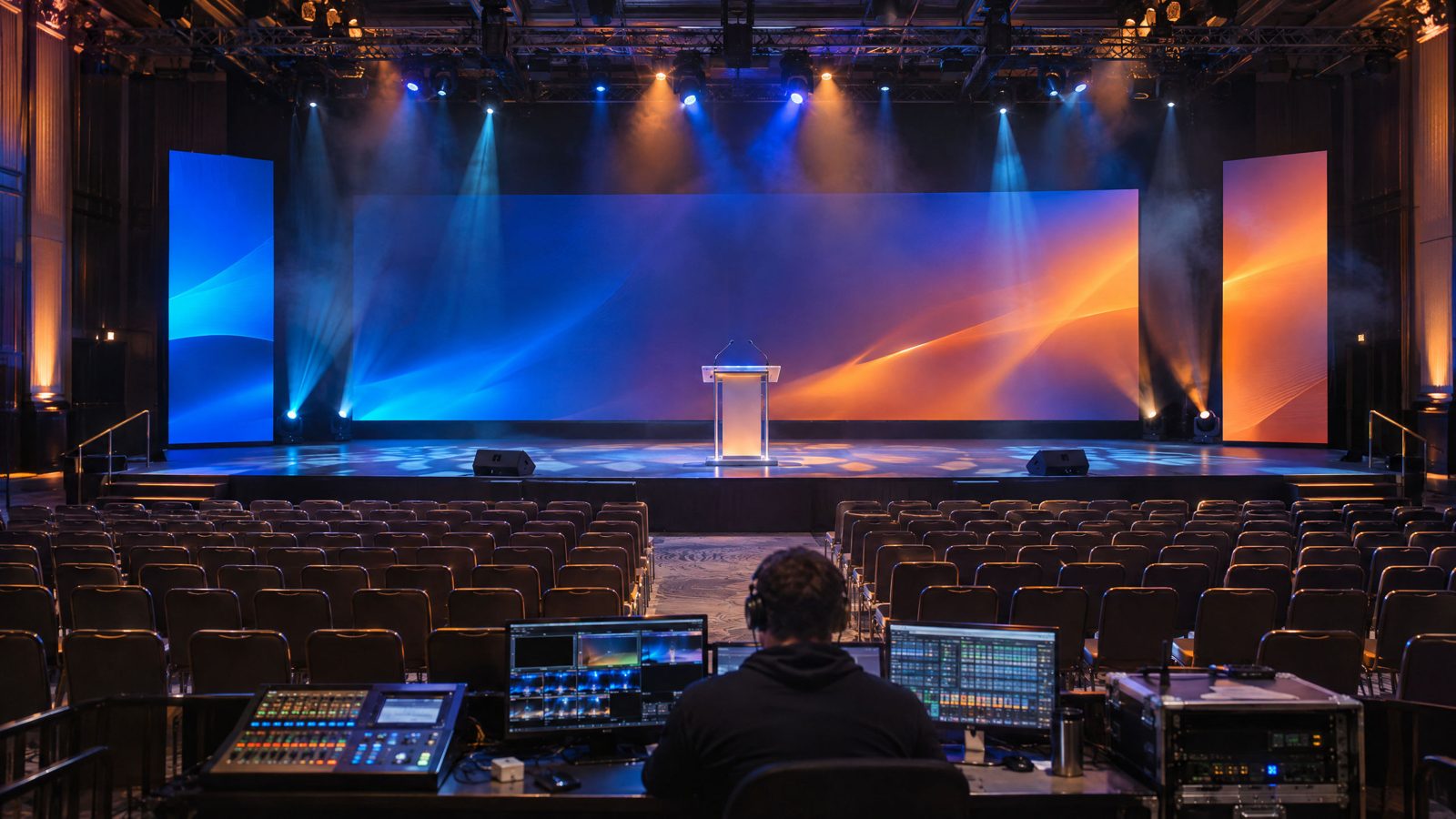
We rent, rig, and run stage walls out of Brooklyn, and we build the content that plays on them. This guide is the planning sequence we use for every stage screen rental, from the layout sketch to show day.
Pick a stage layout first
Before size or pitch, decide what the screen is for. Almost every stage setup is one of three layouts, and each changes the size, budget, and switching.
Single LED backdrop
One wall behind the presenters or performers, running slides, scenery, live camera, or brand content. An LED backdrop for a stage replaces a printed or draped backdrop and becomes the set. It is the most common and simplest setup for keynotes, galas, panels, and smaller concerts. For more on backdrop setups, see our guide to LED backdrop rental.
Flanking IMAG side screens
IMAG (image magnification) screens sit left and right of the stage and show a live camera shot of whoever is on it. They help most in long rooms where faces get small from the back. Without a center wall, they suit stages with a physical set or riser you do not want hidden.
Center wall plus wings
A main backdrop with IMAG screens or wing walls on each side. The center stays on slides and scenery while the wings carry the camera feed. Past about 500 seats, side IMAG becomes the norm. It is the largest build and needs cameras, a switcher, and someone calling cues.
| Layout | Good fit | What sets the size | Switching needs | Trade-off |
|---|---|---|---|---|
| Single backdrop | Keynotes, panels, galas, DJ and band stages | Stage width, clear height, farthest seat | Playback or a laptop feed; a switcher if sources change | Faces stay small in big rooms |
| Flanking IMAG side screens | Long rooms, physical sets, choirs, band risers | Distance to the back of the room | Cameras plus a switcher | No big visual set behind the stage |
| Center wall plus wings | Large keynotes, concerts, rooms past about 500 seats | Stage width, room depth, rigging capacity | Cameras, switcher, media server, show-caller | Most panels, crew, and power |
Size the screen to the stage and the back row
Height from the farthest seat
A common rule of thumb is an image height of about 1/8 to 1/6 of the distance to the farthest viewer, with 1/12 as the absolute back limit. A 48-foot room wants roughly 6 to 8 feet of image height, and an 80-foot room wants 10 to 13 feet. Measure to the real last row or back bar, not the average seat.
Width from the stage
The backdrop should frame the stage without crowding the podium or band. 16:9 is the safe default because speaker decks and edited video arrive that way, so 16 by 9 or 20 by 11 feet come up often. Ultra-wide backdrops look more like a set but need content authored to that exact canvas. Panels are modular, typically 500 mm, so width is flexible. Our LED wall calculator turns a width and height into panel counts and pixel dimensions. For available pitches and what is included with each wall, see our LED screen hire page.
Check the clear height
NYC rooms often cap the size before the audience does. Per our sizing guide, a 12-foot image usually wants 14 to 16 feet of clear height for the structure, and plenty of venues run 10 to 12 foot ceilings. Our LED wall sizing guide has real dimensions by room type.
Match pixel pitch to stage distance
Pixel pitch is the spacing between LEDs in millimeters, and it sets how close someone can get before the image breaks into dots. Match it to your closest viewer. The minimum viewing distance in meters is roughly the pitch number (P2.6 is about 2.6 m, or about 9 ft). The more comfortable "10x rule" puts the distance in feet at about the pitch times 10.
- Close stages and front rows: P1.5 to P2.6. Fine-pitch indoor panels suit close audiences and IMAG shots.
- Main-stage backdrops seen from 15 feet and beyond: P2.6 to P3.9 is typically fine, and a coarser pitch lets you build bigger for the same budget.
- Outdoor stages: outdoor panels with a coarser pitch are built bright to read from a distance.
Streamed or recorded? Tell us early; cameras favor finer pitch and careful brightness settings. Our P1.875 vs P3.91 comparison walks through the trade-off, and COB vs SMD explains the panel construction options for close-viewing stages.
Ground-stacked or flown
Ground-stacked
Panels stand on a ground-support frame behind the stage. It needs no rigging points and is included in every day rate on our pricing page. The trade-off is floor depth, and the bottom of the image has to clear the stage so the audience can see it.
Flown
Panels hang from truss or house rigging points, which keeps the floor clear and lifts the image above heads in a flat room. In general it needs rated points, load calculations, certified rigging, and venue sign-off. Flown rigging is quoted as an add-on, and the venue usually decides between the two. Our ground-stack vs flown rigging guide compares the two in more detail.
Either way, ask the venue early about rigging points, the load-in window, house power, and insurance certificates. Many NYC houses have strict load-in windows.
Brightness, stage lighting, and sightlines
Our indoor walls run about 800 to 1,500 nits, and outdoor walls up to about 5,000 nits. On a lit stage the screen has to sit with the lighting design: too bright and presenters become silhouettes, too dim and it washes out under front light. In a dark concert room the wall usually runs well below its maximum. We set brightness at tech rehearsal, with show lighting on.
For sightlines, walk the room before locking the layout. Check that the image clears heads and the podium from the back row, and that columns, chandeliers, and speakers do not block side screens. Keep confidence monitors downstage so presenters never turn to read the wall.
Content, switching, and the load-in timeline
Every wall has an exact pixel size, and content built to the wrong one shows up stretched or letterboxed. Lock size, pitch, and ratio early and send the pixel dimensions to everyone building slides. We build content in house to your wall's pixel map.
A backdrop running one deck can live on basic processing. Add cameras, multiple presenters, video rolls, or wings, and you need a switcher, a media server, and someone calling cues. Our LED video processor explainer covers where processing ends and switching starts.
A typical stage day runs in this order:
- Weeks out: lock layout, size, pitch, and ratio, then send the pixel map and slide template.
- About a week out: content deadline, with files formatted to the wall and test-played.
- Load-in: rigging or ground support, panel assembly and cabling, calibration, and content testing. Timing depends on wall size and the venue's load-in window, so we confirm it in your quote. Tight turnarounds are covered in our overnight rush installation guide.
- Tech rehearsal: cue-to-cue with lighting, cameras, and confidence monitors.
- Show, then strike: the wall comes down after the last cue or stays built for day two.
For genre-specific detail, see our guides to concert LED walls and conference and keynote stages. Smaller room or a single screen? Our LED screens for events guide and TV rental vs LED wall comparison help you decide whether a stage wall is the right call. For live music, see our concert LED wall rental page.
Frequently asked questions
What size LED screen do I need for a stage?
Start with the farthest seat: a common rule of thumb is an image height of about 1/8 to 1/6 of that distance, so a 48-foot room wants roughly 6 to 8 feet of height. Then fit the width to the stage and check the ceiling, since a 12-foot image usually needs 14 to 16 feet of clear height. Most keynote and gala stages land between 16×9 and 24×12 ft.
How much does a stage LED video wall rental cost in NYC?
On our pricing page, most NYC event walls run $5,000 to $15,000+ per day, all-in. The Stage tier, 16×9 to 24×12 ft with a switcher, media server, rigging, power, and crew, is typically $7–15k per day. Flown concert-scale builds are typically $15–30k+. Extra days drop to roughly 20% of day one.
What pixel pitch is right for an LED backdrop on a stage?
Match pitch to your closest viewer. The minimum viewing distance in meters is roughly the pitch number, and a comfortable distance in feet is about the pitch times 10. Backdrops seen from 15 feet and beyond are typically fine at P2.6 to P3.9. Close stages, front rows, and streamed events do better with a finer pitch.
Do I need IMAG side screens or just a backdrop?
In small and mid-size rooms a single backdrop is usually enough. In long rooms, or past roughly 500 seats, faces get small from the back and edges, so side IMAG screens with a live camera feed help everyone see the speaker or performer.
Should an LED stage screen be ground-stacked or flown?
Ground-stacked is the simpler default: panels stand on a support frame behind the stage and need no rigging points. Flown walls hang from truss or house rigging and keep the floor clear, but need rated points, load calculations, and venue sign-off. The venue's rigging rules usually decide it, so ask early.
Can I hire an LED screen for a stage for just one day?
Yes. Many stage builds are a single show day, and our rates are quoted per day, with extra days dropping to roughly 20% of day one. If you are searching for LED screen hire near you in NYC, send your venue, stage width, and date and we will spec the layout and pitch with a same-day quote.
Planning a stage? See our LED wall rental page for what comes with every build, or send us your venue, stage width, and date and we will spec the layout, pitch, and size with a same-day quote.